
2026 presents significant opportunities for businesses and property owners. However, success requires more than just purchasing hardware. This guide provides a strategic roadmap for location selection, professional installation, and revenue optimization.
The Current Landscape for EV Charger in Canada
First, understanding the market context is crucial. The Canadian government actively supports EV adoption with new funding programs. Recently, the government announced funding for 8,000 new charging ports across the nation . This investment aims to build a robust network from coast to coast. Therefore, the demand for reliable infrastructure is higher than ever.
Moreover, industry standards are evolving to ensure safety and interoperability. The Standards Council of Canada is developing a new deployment guideline. This document will address installation, reliability, and accessibility for all users . For businesses, adhering to these guidelines ensures long-term viability. It also builds trust with EV drivers seeking a seamless experience.
Strategic Location Selection
Choosing the right location is the first step to maximizing your return. An EV charger in Canada generates profit through utilization. High-traffic areas naturally see more usage and, therefore, more revenue.
High-Flow Retail and Service Centers:
For instance, large supermarkets, shopping malls, and home improvement stores are ideal. Drivers often spend 30 minutes to an hour at these locations. This duration is perfect for a mid-session charge.
Transportation Hubs and Urban Zones:
Additionally, airports, train stations, and major highway service areas are prime real estate. These locations cater to drivers needing a top-up while commuting or traveling. City parking lots also represent a consistent source of daily users.
Destination and Fleet Locations:
Furthermore, hotels, restaurants, and tourist attractions can attract EV-driving customers. Offering EV charger station can be a competitive advantage. Logistics centers and depots also need dedicated infrastructure for electric fleets.
Understanding Your Installation Options
Selecting the correct equipment depends on your location and target users. A commercial EV charger in Canada generally falls into two main categories.
AC Charging Solutions
Firstly, AC EV chargers are ideal for locations where vehicles park for extended periods. These are perfect for residential areas, workplaces, and hotel guests. Common power outputs include 7kW, 11kW, and 22kW models. They typically use Type 1 or Type 2 connectors to accommodate various vehicles.
DC Fast Charging Solutions
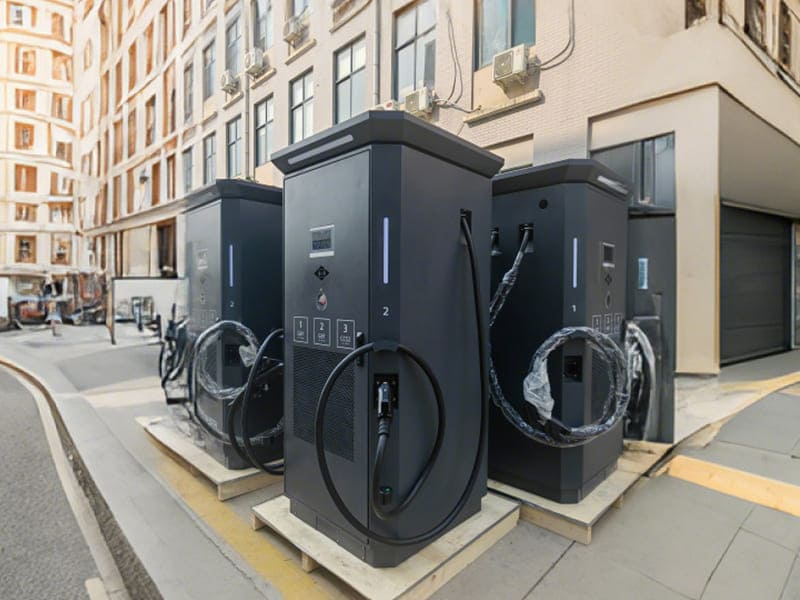
Secondly, DC fast chargers are essential for high-traffic and highway locations. They provide significant range in a short time, reducing wait times. Options range from compact 20kW units to powerful 320kW systems. Many units feature dual or triple connectors (like CCS1, CCS2, CHAdeMO, and NACS). This ensures compatibility with all vehicle models, maximizing accessibility. For massive installations, 480kW split-type charging stations can service multiple vehicles simultaneously.
The Importance of Professional Installation
Professional installation is non-negotiable for safety and compliance. Every EV charger in Canada must adhere to the Canadian Electrical Code . Permits are mandatory for most commercial and residential hardwired installations. Therefore, hiring a certified electrician is essential.
A professional will conduct a thorough load calculation first. This step verifies that your existing electrical service can handle the new demand. If necessary, they can recommend an Energy Management System . These systems balance power between the charger and other building loads, avoiding costly service upgrades.
Maximizing Your Profit Margins
Owning an EV charger in Canada can be a profitable venture with the right strategy. Revenue is generated through pay-per-use fees, subscription models, or increased customer spending.
Optimize Your Revenue Mix:
Service and subscription revenue are proving to be key growth areas in the industry. Companies are seeing improved margins by focusing on higher-margin deployments and service contracts . Therefore, consider offering a tiered pricing structure for different user groups.
Leverage Available Incentives:
Government grants can significantly offset upfront capital costs. For example, Natural Resources Canada’s ZEVIP program funds charging infrastructure installations. Utilizing these programs improves your initial return on investment. It also allows you to install more advanced, higher-margin equipment. How do EV charger guidelines impact the selection of connectors and charging modes for commercial projects?
Choose a Reliable Partner:
Finally, your choice of manufacturer impacts your long-term profitability. Aegen, for example, manufactures a full range of AC and DC chargers. They sell complete units and components while offering free technical support. Aegen also provides EV charging testers for installers and assemblers. Partnering with an experienced manufacturer ensures equipment reliability. Their global experience across Europe, South America, and the Middle East translates to proven, durable products for the Canadian market.
In conclusion, the Canadian EV charging sector is poised for substantial growth. By carefully selecting locations, installing the right equipment professionally, and optimizing your business model, you can secure a strong profit margin in 2026 and beyond.