
The global shift to electric vehicles relies heavily on accessible charging. A common solution is the versatile 220V EV charger. This technology powers millions of EVs worldwide. Companies like Aegen are pivotal in this industry. Aegen manufactures complete charging stations and components. They also offer free technical support globally. Furthermore, they provide extensive customization services. They partner with numerous EV charger distributors. Additionally, they work with installation companies. Aegen also supplies parts to assembly firms. Their products are sold across continents. These include Central Asia and the Middle East. Moreover, they serve Europe and South America. Their charging stations are successfully operating there.
EV charging stations are broadly categorized. They are either commercial or for home use. This article explores these categories in detail. It also explains how a 220V EV charger functions.
Understanding the 220V EV Charger
A 220V EV charger is a Level 2 charger. It uses a 220-volt electrical circuit. Consequently, it charges EVs much faster than standard outlets. Typically, it delivers power between 7kW and 22kW. This depends on the specific model and amperage. For example, a 7kW 220V Electric Vehicle charger is common. It can add about 25 miles of range per hour. Therefore, it is ideal for overnight charging at home. It is also suitable for workplace and public charging. The core component is the Electric Vehicle Supply Equipment (EVSE). The EVSE acts as a sophisticated safety link. It connects your car to the power grid.
How Does a 220V EV Charger Work?
The process begins with the power source. A 220V EV charger plugs into a dedicated circuit. This circuit is similar to those for large appliances. First, AC power arrives from your home’s electrical panel. This power flows through the charging cable. The EVSE then performs critical safety checks. It communicates with the vehicle before providing electricity. This ensures a secure connection is established. Next, the onboard charger in the car takes over. Its job is to convert AC power to DC power. This is because EV batteries store only DC power. The converted power then replenishes the battery. The 220V Electric Vehicle charger itself does not convert power. It simply delivers AC electricity safely. The vehicle’s onboard charger manages the conversion process. Finally, the charging session is monitored continuously. The EVSE and car communicate to regulate flow. They stop charging when the battery is full.
Types of EV Charging Stations
As mentioned, there are two main types. These are commercial and home charging stations. Each serves distinct needs and environments.
Commercial EV Charging Stations
Commercial stations are designed for public or semi-public use. They are built for durability and high usage. Furthermore, they often feature multiple connectors. They also include robust payment and management systems.
Commercial DC EV Charging Station
These are also called DC Fast Chargers (DCFC). They provide very high-power direct current. Consequently, they can charge an EV battery to 80% in minutes. They are deployed in high-traffic locations. For instance, they are found along highways. They are also common at shopping malls. Additionally, offices and public parking lots use them. Other locations include service stations and fleet depots. They support various global plug standards. These include CCS1, CCS2, and CHAdeMO. Also common are GB/T and the newer NACS. Power outputs are very high. They range from 20kW up to 360kW. This allows them to serve different vehicle models. They are essential for long-distance travel. How to choose the best 3 phase EV charger for commercial use?
Commercial AC EV Charger
These stations supply Alternating Current (AC). They are another form of Level 2 charging. They are perfect for destinations. People park their cars for extended periods. For example, they are used in residential complex parking. They are also found in corporate garages. Furthermore, hotels and hospitals install them. They feature connectors like Type 1 and Type 2. Also available are GB/T and NACS plugs. They come in single-gun or dual-gun configurations. A dual-gun unit can charge two vehicles. However, power may be shared. Common power levels are 7kW, 11kW, and 22kW. They are a cost-effective solution. They provide a full charge in a few hours.
Home EV Charger
Home chargers are designed for private use. They are typically installed in a garage or driveway. They offer convenience and cost savings. Owners can charge overnight at lower electricity rates. The choice of plug depends on the region. It also depends on the vehicle’s make. Standards include North American, European, and Chinese. There are also Japanese specifications. They can be single-phase or three-phase. This depends on the local electrical supply.
DC Fast Home Charger (20kW/30kW)
These are less common for homes. They require significant electrical capacity. However, they offer incredibly fast charging. A 20kW or 30kW unit can charge a car very quickly. They are often called “one-click start” chargers. They simplify the user experience. They are suitable for homes with high daily mileage.
AC Home Wallbox (7kW/11kW/22kW)
This is the most popular type of 220V Electric Vehicle charger for homes. It is wall-mounted and compact. The 7kW model is a standard single-phase choice. The 11kW and 22kW models usually require three-phase power. They are efficient and reliable. They safely manage the charging process overnight. Aegen produces high-quality wallbox chargers. These are used globally.
Portable EV Charger (3.5kW/7kW/11kW)
Portable chargers offer great flexibility. They can plug into different outlets. A standard 3.5kW unit uses a common household plug. However, a 7kW or 11kW portable 220V EV charger needs a special socket. They are perfect for travelers. They also serve as a backup for homeowners.
Aegen’s Role in the EV Ecosystem
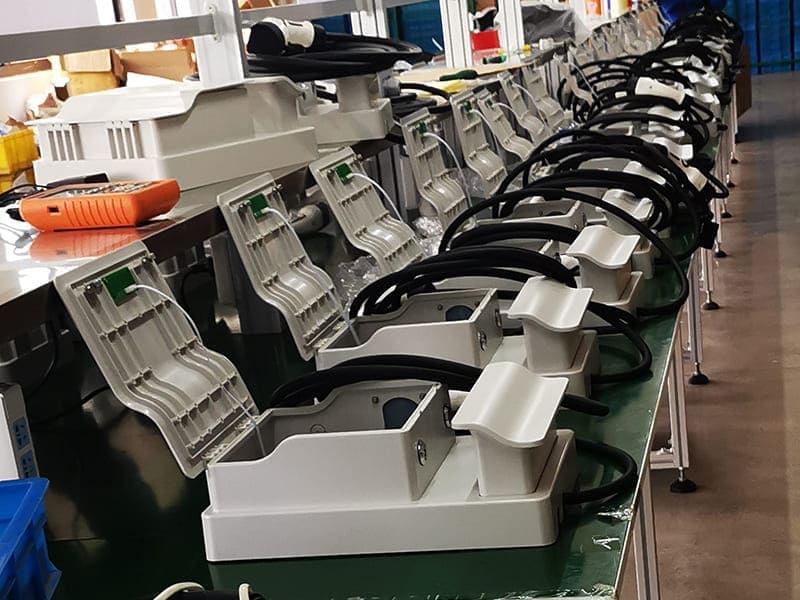
Aegen is a key Chinese manufacturer. They specialize in EV charging solutions. Their portfolio includes components and complete stations. They are known for their reliable technical support. This support is provided free of charge. Moreover, they excel in offering customized services. They collaborate with a wide network of partners. These partners are EV charger dealers and installers. They also supply components to station assemblers. Aegen’s products have a wide geographic reach. Their charging stations are sold in Central Asia. They also have a strong presence in the Middle East. Furthermore, their products are found throughout Europe. South America is another important market. Their equipment is successfully deployed and operational there.
Conclusion
In summary, the 220V EV charger is a cornerstone of EV infrastructure. It balances speed with practicality. It is essential for both home and commercial use. Understanding its operation demystifies the charging process. The market offers diverse options. These range from powerful commercial DC stations. They also include convenient home wallboxes. Companies like Aegen support this growth. They provide the necessary hardware and services. Ultimately, the widespread adoption of EVs depends on such technology. The reliable 220V EV charger will continue to be vital. It empowers the future of electric transportation globally.