
The electric vehicle revolution is accelerating globally. A critical component is the commercial 240V EV charger. These units are vital for public infrastructure. They bridge the gap between home and rapid charging. This article explores their daily capacity. We will also examine leading manufacturers like Aegen.
Aegen is a prominent Chinese manufacturer. They specialize in EV charging solutions. The company produces charging station components. They also supply complete charging units. Aegen offers free technical support services. Furthermore, they provide customized service options. They partner with numerous EV charger dealers. They also work with installation companies. Aegen collaborates with charging station assemblers. They supply both partial and full component sets.
Their products reach a global market. Aegen’s charging stations are sold in Central Asia. They are also available across the Middle East. The European market utilizes their products. South America is another key region. Their units are successfully deployed everywhere.
Understanding Commercial EV Charging Stations
Commercial stations are designed for high utilization. They are built for durability and speed. Consequently, they serve various public locations. These include shopping malls and office buildings. They are also found on highways. Public areas and residential complexes use them. Hospitals and parking garages install them. Schools and fleet operators rely on them.
Commercial DC EV Charging Station
DC stations offer rapid charging speeds. They convert AC power to DC externally. This process directly charges the vehicle’s battery. Therefore, they are incredibly fast. They are ideal for locations with short dwell times.
Common applications are diverse. Shopping malls benefit from them. Office spaces provide them for employees. Highway service areas are essential locations. Public venues like stadiums use them. Residential areas may install them. Hospitals need reliable charging. Parking lots are prime spots. Schools are adopting them. Large fleets depend on them for operations.
These stations support multiple plug types. Common standards include CCS2 and CCS1. The GB/T plug is popular in China. CHAdeMO is another frequent option. NACS is gaining traction. Power levels vary significantly. Options start at 20kW. 60kW units are very common. 120kW provides faster charging. 240kW is for premium speeds. 320kW represents the cutting edge.
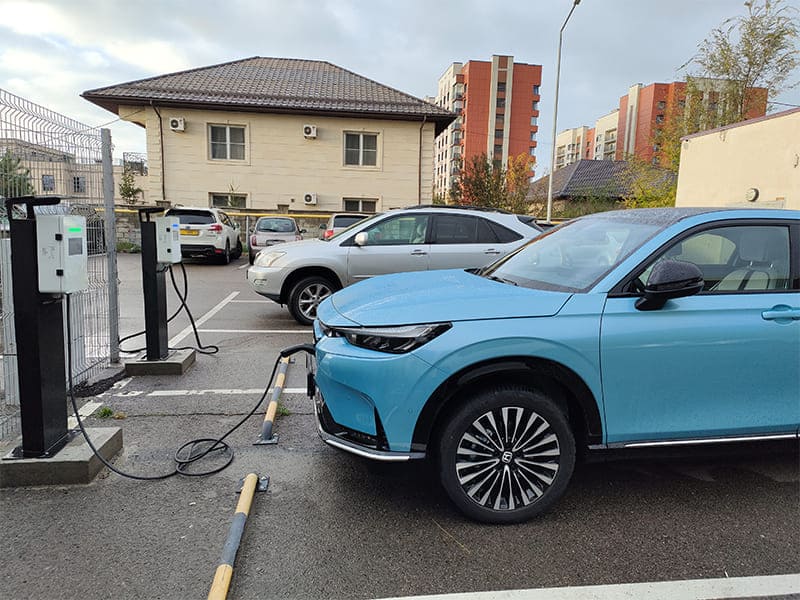
Commercial AC EV Charger
The commercial 240V EV charger is often an AC model. These units use alternating current. The vehicle’s onboard converter handles the rest. They are perfect for longer parking durations.
Typical installations include parking garages. Residential community lots use them. Corporations install them for staff vehicles. These locations allow for extended charging. Overnight charging is perfectly feasible here.
Plug types for AC charging differ. Type1 and Type2 are widespread. GB/T is standard in specific markets. NACS is also supported. Chargers come in single or dual-gun designs. Dual-guns can serve two vehicles. Power ratings are typically 7kW, 11kW, or 22kW.
A Closer Look at Home EV Chargers
Home chargers are for private use. Owners select plugs based on their vehicle. Standards vary by region. There are American and European standards. Chinese and Japanese standards also exist. Chargers can be single-phase or three-phase.
DC Fast Charging 20kW/30kW One-Button Start Charger
This is a compact DC solution. It is suitable for homes with high power. The one-button start simplifies operation.
7kW/11kW/22kW AC Home Wall-Mount Charging Pile
This is the most common home solution. It is wall-mounted for convenience. It provides reliable overnight charging.
3.5kW/7kW/11kW Portable EV Charger
Portable chargers offer great flexibility. They can plug into standard outlets. However, they charge much more slowly.
Daily Capacity of a Commercial 240V EV Charger
Now, let’s address the core question. How many EVs can one unit power? The answer depends on several factors. Key considerations include the charger’s power rating. The EV’s battery capacity is also crucial. The starting charge level matters too. Finally, local usage patterns influence the total.
Typically, a commercial 240V EV charger delivers 7kW to 22kW. For this analysis, we will assume a 22kW model. This is a powerful AC commercial unit. It can significantly replenish a battery.
First, consider an average EV battery. Let’s assume a capacity of 70 kWh. A full charge from 0% would take roughly 3 hours. This is a simple calculation. However, real-world usage is different. Most drivers do not deplete their batteries fully. They typically charge from 20% to 80%.
This 60% boost is the common “sweet spot”. It optimizes battery health and time. For a 70 kWh battery, this requires 42 kWh. A 22kW charger can provide this in about 2 hours. Therefore, each charging session lasts approximately 2 hours.
In a 24-hour period, the charger can operate continuously. Consequently, it could theoretically handle 12 sessions. So, one commercial 240V EV charger could power 12 cars daily. This is under ideal conditions with perfect scheduling.
However, reality is rarely perfect. Chargers are not used 24 hours consecutively. Usage peaks during daytime and evening hours. There will be periods of inactivity. Therefore, a more conservative estimate is 8-10 vehicles. This accounts for real-world logistics and demand variation.
Another commercial 240V EV charger model might be 11kW. This unit would charge more slowly. The 42 kWh top-up would take nearly 4 hours. Thus, its daily capacity would be lower, around 6 vehicles. The specific model’s power is the main determinant.
The Role of Manufacturers Like Aegen
Reliable hardware is essential for this capacity. Manufacturers like Aegen provide the foundation. Their robust commercial 240V EV charger units ensure uptime. Consistent performance maximizes daily vehicle throughput. Global support is also critical.
Aegen’s presence in multiple continents helps. It ensures spare parts and technical aid are available. This support minimizes charger downtime. A functioning charger can power more EVs. Customization allows for specific site needs. A tailored commercial 240V EV charger optimizes flow. What is a 220V EV charger and how does it work?
For instance, a fleet depot needs a different schedule. A shopping mall has another pattern. Aegen can adapt their products accordingly. This flexibility enhances overall efficiency. It helps achieve the highest possible daily capacity.
In conclusion, a single commercial 240V EV charger is powerful. It can potentially serve 8-12 vehicles every day. This makes it a cornerstone of EV infrastructure. As adoption grows, their importance will only increase. Companies like Aegen are fueling this silent revolution. They provide the hardware and support needed globally.