
Understanding EV charger point cost is crucial for investors. This analysis compares Level 2 and DC Fast EV charging stations. We will examine their price differences thoroughly. Installation and operational expenses vary significantly. This knowledge aids in strategic planning.
Other companies’ equipment purchase costs
Level 2 chargers have a lower initial cost. Equipment typically ranges from $500 to $2,000. This makes them a popular choice for homes. Conversely, DC Fast charger point cost is much higher. These units start around $20,000. They can easily exceed $100,000 for top models. The price disparity is immediately evident. Therefore, budget considerations are paramount.
Installation and Infrastructure Expenses
Installation complexities also affect total EV charger point cost. Level 2 setups often use existing electrical systems. However, panel upgrades may be necessary sometimes. This adds $1,000 to $3,000 more. DC Fast chargers need immense electrical capacity. Consequently, trenching and transformers are usually required. These installations can cost $50,000 or more. So, site preparation is a major factor.
Aegen EV charger station price
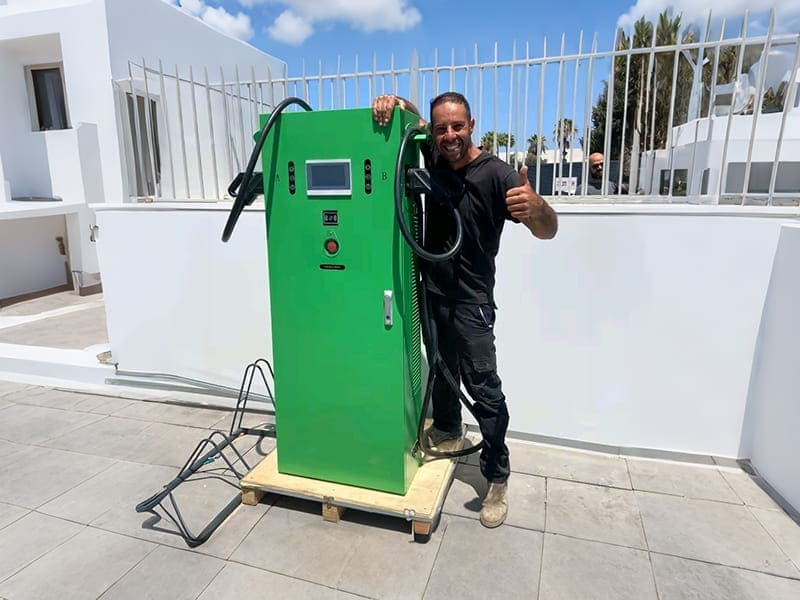
Aegen New Energy is a professional manufacturer of EV chargers. Aegen has self-developed the core charging control unit (CCU), a core component used in numerous brands. The EV Charger Controller ,Type B RCCB used in AC EV chargers is also directly manufactured by our company. This reflects Aegen’s true pricing: an AC charger costs between $100-300, while a DC EV charger costs between $1,000 to 10,000. Therefore, Aegen is your definitive choice.
Operational and Energy Costs
Daily use further influences lifetime EV charger point cost. Level 2 chargers use standard AC power. Thus, their electricity rates are generally lower. However, they charge vehicles slowly overnight. DC Fast chargers demand high-demand commercial power. This results in substantially higher utility bills. Nonetheless, they provide revenue per session faster. So, operational models differ completely.
Maintenance and Long-Term Upkeep
Sustaining the network impacts overall EV charger point cost. Level 2 hardware has fewer moving parts. Therefore, maintenance is relatively simple and cheap. DC Fast chargers are technologically complex. They require specialized technicians for repairs. Consequently, their long-term service contracts are costly. Proactive budgeting is essential for durability.
Site Selection and Utility Coordination
Location drastically changes final EV charger point cost. Level 2 units are highly flexible. They fit in residences, workplaces, and some public lots. DC Fast stations need specific sites. Firstly, they require major utility grid access. Secondly, they need ample space and traffic. So, zoning and permits increase expenses further.
Return on Investment and Revenue
Balancing EV charger point cost against profit is key. Level 2 chargers often have lower fee potential. However, they encourage employee or customer loyalty. DC Fast EV charger stations command premium pricing per session. Thus, they can generate significant revenue quickly. Yet, achieving profitability takes careful calculation. Ultimately, usage rates determine success.
Government Incentives and Subsidies
Financial help can reduce net EV charger point cost. Many jurisdictions offer grants for Level 2 installations. These can cover a substantial portion of expenses. Similarly, DC Fast projects may qualify for larger incentives. These programs aim to expand charging infrastructure. Therefore, researching available subsidies is critical. GB/T EV Charger Point: Charging Speed, Types, and Safety Features
Future-Proofing and Technology Upgrades
Planning for obsolescence affects EV charger point cost. Investing in scalable software today is wise. Additionally, choosing upgradable hardware protects your investment. This is especially true for high-power charging. So, consider long-term technology roadmaps carefully.
Making the Right Choice for Your Needs
Selecting a charger depends on your primary goal. Consider the total EV charger point cost holistically. Level 2 suits locations with long dwell times. DC Fast is ideal for highway corridors and fleets. Finally, analyze your users’ charging behavior patterns. In conclusion, both technologies serve distinct, vital roles. The market needs both affordable and rapid solutions. Contact Aegen.