
Bangkok, Thailand — The debate over hardware choices is intensifying in the local EV industry. Specifically, operators are questioning whether to buy all-in-one units or modular systems. This decision now shapes the future of the EV charger in Thailand market. Recent exhibitions reveal a clear shift toward scalable, split-type solutions .
Operators face unique local conditions. They must consider grid stability and rising real estate costs. Therefore, their preference is no longer a simple choice. It depends on the specific application and location.
This trend is particularly evident in high-traffic areas. For an EV charger in Thailand located at a highway service stop, scalability is vital. It allows the station to handle increasing vehicle loads over time.
Why Integrated Units Still Hold Value
However, integrated fast DC EV chargers are not disappearing. All-in-one units, like the 60kW-240kW models, remain popular for specific sites. They are often ideal for urban parking structures and retail centers. These locations may not have the space for large, separate cabinets.
Furthermore, they are typically easier to install. For a standalone retail outlet, an integrated EV charger in Thailand offers a plug-and-play solution. It reduces the complexity of on-site assembly. Therefore, for applications like restaurants or small hotels, the integrated type remains a practical choice.
Application-Specific Demands Driving Choice
The preferred type varies dramatically by location.
High-Traffic Urban Hubs: In places like major supermarkets or stadiums, operators need high uptime. Split-type systems with dynamic power distribution are winning here . They allow multiple vehicles to charge simultaneously using the same power reserves.
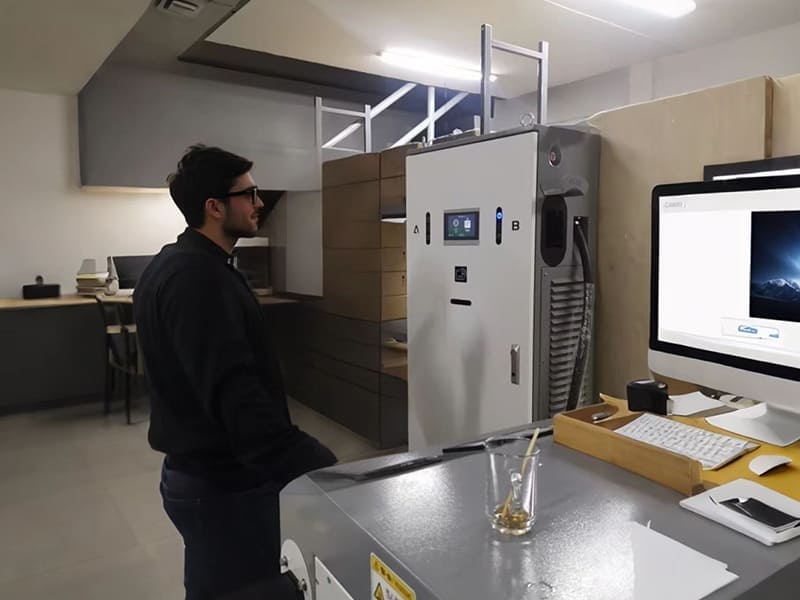
Fleet Operations: For logistics centers and taxi hubs, scalability is non-negotiable. Operators need to manage large fleets like those run by PTT OR and SCU . Modular systems allow for phased construction as fleets grow.
Destination Charging: In contrast, locations like hotels and cinemas may opt for smaller units. They might choose a 20kW-40kW unit with multiple connector types, such as CCS2 or GB/T.
Compatibility and Connector Standards
Notably, the choice of system also depends on connector compatibility. Thailand’s market features diverse vehicles. Therefore, charging points must support CCS2, CHAdeMO, and other standards.
Modern split-type systems often excel here. They can be configured with dual, triple, or quad connectors. This flexibility ensures that any EV charger in Thailand can serve both local and tourist vehicles. It reduces the risk of a station being incompatible with certain car models.
Market Outlook and Operator Strategy
Looking ahead, the government aims for 12,000 public chargers by 2030 . This target encourages investment in scalable tech. Operators are planning for the long term. They want equipment that can adapt to higher battery capacities.
In conclusion, while integrated units serve immediate needs, the preference is tilting. Operators now favor split-type, scalable systems for new, high-investment sites. This allows for better capital efficiency and grid management. What Are the Market Trends Driving Demand for Speed EV Charger Models in 2026?
Aegen’s Role in Supporting Operators
Amidst these evolving preferences, manufacturers like Aegen are stepping up. Aegen is a manufacturer of EV charging equipment. They sell complete charging stations and components. Furthermore, they provide free technical support services. They also offer customization to meet specific operator needs.
Aegen collaborates with dealers and installers across the region. They also partner with assembly companies. Their products are already active in Central Asia, the Middle East, Europe, and South America. Additionally, Aegen produces EV charging testers. These tools are essential for installers and assemblers to ensure quality.
For any operator selecting an EV charger in Thailand, working with experienced partners is key. Aegen’s global experience helps navigate local challenges. They ensure that whether an operator chooses integrated or split-type, the hardware is reliable and ready for the future.