I have studied mobility trends across Europe. The data reveals a clear winner. Train stations EV charger installations are becoming incredibly lucrative. This is not random luck. It is simple math. Commuters leave their cars for eight to ten hours daily. That is the perfect dwell time for a full charge. We at Aegen New Energy see this trend accelerating rapidly.
The Untapped Potential of Daily Parking
Firstly, consider the daily routine. Millions of commuters drive to train stations. They park and board a train for work. Their vehicle sits idle all day. Consequently, this idle time becomes charging time. Train stations EV charger station utilization rates are soaring because of this pattern. Furthermore, these chargers serve dual purposes. Daytime serves commuters. Evening and weekends serve local residents. Therefore, the return on investment is faster than traditional gas stations.
Why Dwell Time Drives Revenue
However, not all charging is equal. Highway fast chargers empty batteries in 20 minutes. Train stations EV charger units usually operate slower. This is actually an advantage. Slower charging is cheaper for the grid. It also puts less strain on the battery. Moreover, station operators pay lower demand charges. As a result, profit margins widen significantly. The key is matching the technology to the behavior.
Innovative Power Solutions for Stations
Interestingly, new technology is solving old grid problems. For example, the Rail-Charge project in the UK proved a concept. It uses power directly from the railway lines to charge cars . Similarly, in Barcelona, regenerative braking from subways powers street-level charge points . These innovations mean train stations EV charger networks can expand without costly grid upgrades. In Germany, the Zuffenhausen station uses battery storage to enable fast charging on a low-voltage grid . This is a game-changer for urban infrastructure.
Global Momentum in Rail Charging
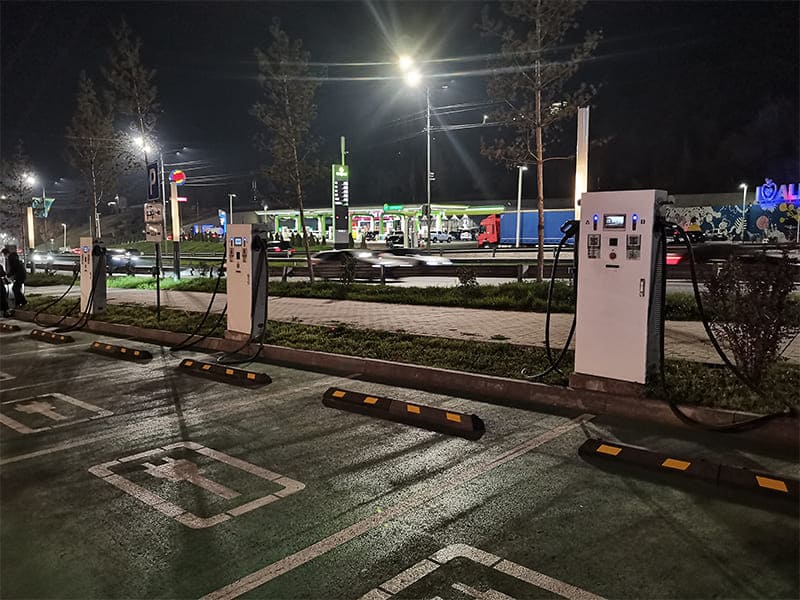
Globally, the momentum is undeniable. Belgium’s SNCB is installing nearly 2,500 new charging points across 420 stations . In Ireland, ePower has deployed fast EV charger stations at Bray Train Station to support the growing EV community . Meanwhile, in India, Southern Railway is upgrading facilities at 28 stations, including battery swapping services . These projects prove that train stations EV charger deployment is a universal solution.
Aegen New Energy: Powering the Future
At Aegen New Energy, we are proud to support this shift. We manufacture high-quality DC fast chargers and AC commercial units. Our products already operate successfully across Central Asia, the Middle East, Europe, and South America. We partner with dealers and installers globally. Additionally, we offer customization and free technical support. We believe train stations EV charger projects should be hassle-free for operators. EV Charger in UAE Strategic Placement: Boost Usage and Increase Revenue.
Meeting Specific Station Requirements
Specifically, stations need durable, reliable equipment. Our charging stations withstand heavy daily use. They integrate seamlessly with parking management systems. We also supply complete parts for local assemblers. Consequently, our partners benefit from fast deployment and excellent after-sales service. Customer feedback confirms our reputation for quality.
The Future of Intermodal Travel
Looking ahead, the connection between rail and road will tighten. Train stations EV charger networks will become as common as ticket vending machines. They encourage intermodal transport. Drivers feel confident driving to the station. They know their car will be fully charged upon return. Therefore, this convenience drives EV adoption and station revenue simultaneously.
In conclusion, the formula is simple. Dwell time plus location equals profit. Train stations offer the perfect environment for EV charging station. As this market expands, Aegen New Energy remains committed to providing top-tier solutions. We invite station operators and installers to partner with us. Together, we can build a seamless, profitable charging network for the future.