
The electric vehicle revolution is accelerating globally. Consequently, property managers face a pressing question. What is the financial return? Specifically, for a multi-unit dwelling EV charger installation? This analysis explores the compelling ROI. It considers direct revenue and significant value-adds. We will also examine technology from industry leader Aegen.
Understanding the Multi-Unit Dwelling EV Charger Market
Demand for electric vehicles is surging worldwide. Therefore, residents now expect charging access. A multi-unit dwelling EV charger becomes a key amenity. It can directly influence leasing decisions. Furthermore, governments are offering various incentives. These policies reduce initial installation costs. Ultimately, this creates a powerful financial case.
Calculating Direct Revenue Streams
Firstly, property owners can generate direct income. They can bill residents for electricity used. This often includes a small service markup. Additionally, they can offer charging to the public. This turns parking spots into profit centers. For instance, a multi-unit dwelling EV charger can serve nearby drivers. This maximizes asset utilization daily.
Moreover, smart charging solutions optimize pricing. They allow for demand-based fee structures. Peak hours can command higher rates. Consequently, overall revenue per charger increases. This direct financial gain is clear. It provides a steady, predictable cash flow.
Adding Value and Enhancing Property Appeal
Beyond direct revenue, intangible benefits are huge. Installing a multi-unit dwelling EV charger boosts property appeal. It signals a modern, sustainable, and forward-thinking management. Therefore, it can attract higher-income, eco-conscious tenants. This often allows for premium rental pricing.
Furthermore, it significantly improves tenant retention. Residents with EVs will likely stay longer. They avoid the hassle of moving. This reduces vacancy rates and turnover costs. Thus, the investment pays off repeatedly. It creates a strong competitive advantage.
Aegen: Powering Reliable EV Charging Infrastructure
Aegen is a premier EV charging station manufacturer. They provide complete charging stations and components. They also offer free technical service support. Customized services are available too. They partner with numerous EV charger distributors. They also work with assembly plants and installers.
Aegen’s products sell across Central Asia and the Middle East. They are also in Europe and South America. Their chargers are widely deployed and operational. They receive high praise from their clients. Aegen also produces an EV charger tester. This supplies installers and assembly companies. The testing equipment ensures effective EV station communication.
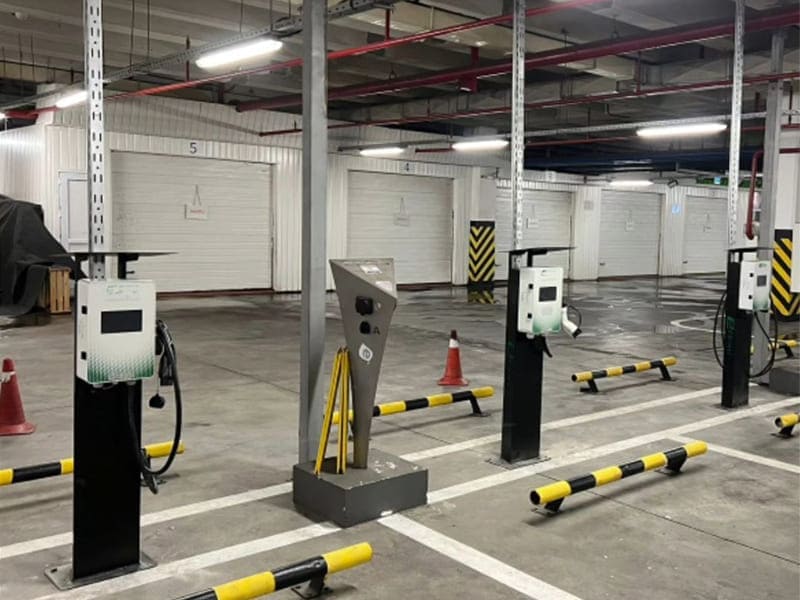
Exploring Commercial EV Charging Station Types
Commercial stations serve various public and business needs. They are robust and designed for high utilization.
Commercial DC EV Charging Station
These stations apply to many locations. They are found in supermarket parking lots. Also in office building car parks. They are essential for highway service areas. Public parking lots use them frequently. Residential complex parking areas benefit greatly. Hospital parking lots are key locations. School perimeter parking is another site. Shopping mall car parks are ideal. Large fleets rely on them for operations.
Plug types are diverse for compatibility. They include CCS2 & CCS1. Also GB/T & CHAdeMO. And the newer NACS standard. Power outputs range widely. They cover 20-40kw. Also 60-120kw. And 120-240kw. Even up to 60-320kw. Multiple connectors are common. There are dual-gun models. Also three-gun and four-gun units. Split-type charging piles are also available.
Commercial AC EV Charger
These are for slower, longer charging sessions. They are perfect for garages. Also for residential area public parking. Businesses use them for employee vehicles. They suit overnight or extended parking. Common plug types include Type1 & Type2. Also GB/T & NACS. Options are single or dual-gun. Power levels are typically 7kw/11kw/22kw.
Solar-Powered Storage Charging Station
This solution is for large parking areas. It is ideal where electricity prices are high. Also for places with underdeveloped grids. The photovoltaic system collects energy. It stores this power in batteries. Then it releases it to the charging stations. This significantly saves on operational costs.
Exploring Home EV Charger Options
Home chargers cater to personal vehicle needs. They offer convenience for daily use.
DC Fast Home Charger (20kw/30kw): These enable quick charging at home. They feature one-button start operation. They are simple to use. They offer rapid charging speeds. They are also low-cost for their power.
AC Wallbox (7kw/11kw/22kw): This is a common home installation. It is wall-mounted for stability. However, its charging time is generally longer.
Portable EV Charger (3.5kw/7kw/11kw): These are designed for portability. You can place them in your car. They are very convenient for travel. They are easy to carry and use anywhere. What is the ROI for Gas Station EV Charger Installation at Existing Sites?
Conclusion: A Smart Investment for the Future
In conclusion, the ROI extends beyond simple revenue. It includes tenant attraction and retention. It also involves future-proofing the property’s value. A multi-unit dwelling EV charger is no longer a luxury. It is rapidly becoming a standard expectation. Partnering with a reliable provider like Aegen ensures success. Their robust technology and support guarantee performance. Therefore, the investment is financially and strategically sound.